GUARD DEVICES
Medical Network Guard
Security at the wire, for legacy medical devices
Partner for Medical GuardConnected equipment that can't be secured
Hospitals are full of essential, network-connected legacy equipment, that can’t be secured in the usual ways, from imaging machines to infusion pumps, from patient monitors to laboratory analysers, and more.
Hospitals use a variety of security measures including firewalls, network segmentation and passive monitoring, but these measures do not solve the underlying problem.
key challenges
-
Hospital equipment needs to last a minimum of 15 years, but software support typically ends after a decade, leaving no options for threat mitigation.
-
Medical devices are in daily use and need to interact with other hospital systems. There is rarely a maintenance window.
-
Monitoring tools such as firewalls can flag suspicious activity, but cannot stop it.
-
Putting a conventional security appliance in front of an un-patchable device shifts the risk rather than removing it.

IN DEVELOPMENT
A network guard for legacy device security
Kry10 has been working with our partner Galois on the US federal government's Advanced Research Projects Agency for Health (ARPA-H) UPGRADE (Universal PatchinG and Remediation for Autonomous Defense) program. This USD43m program has the goal of fortifying medical devices against cyber threats.
What Kry10 needed to create

As part of the ARPA-H project, Kry10 was sub-contracted to provide a bump-in-the-wire guard, that sits between a single device (in this case, infusion pumps) and the rest of the hospital network. All traffic to and from that device was required to pass through the device, which also needed the following characteristics:
- Ability to host defenses configured specifically to that device and its vulnerabilities.
- Requires no change to the protected device, no firmware update, no reconfiguration and no network redesign.
- Invisible to everything around it.
- Integrates with the other teams' tools, increasing seamless interoperability for the hospital.
- Adds minimal administrative burden to the existing workforce.
HOW THE MEDICAL GUARD WORKS
Kry10 Medical Guard
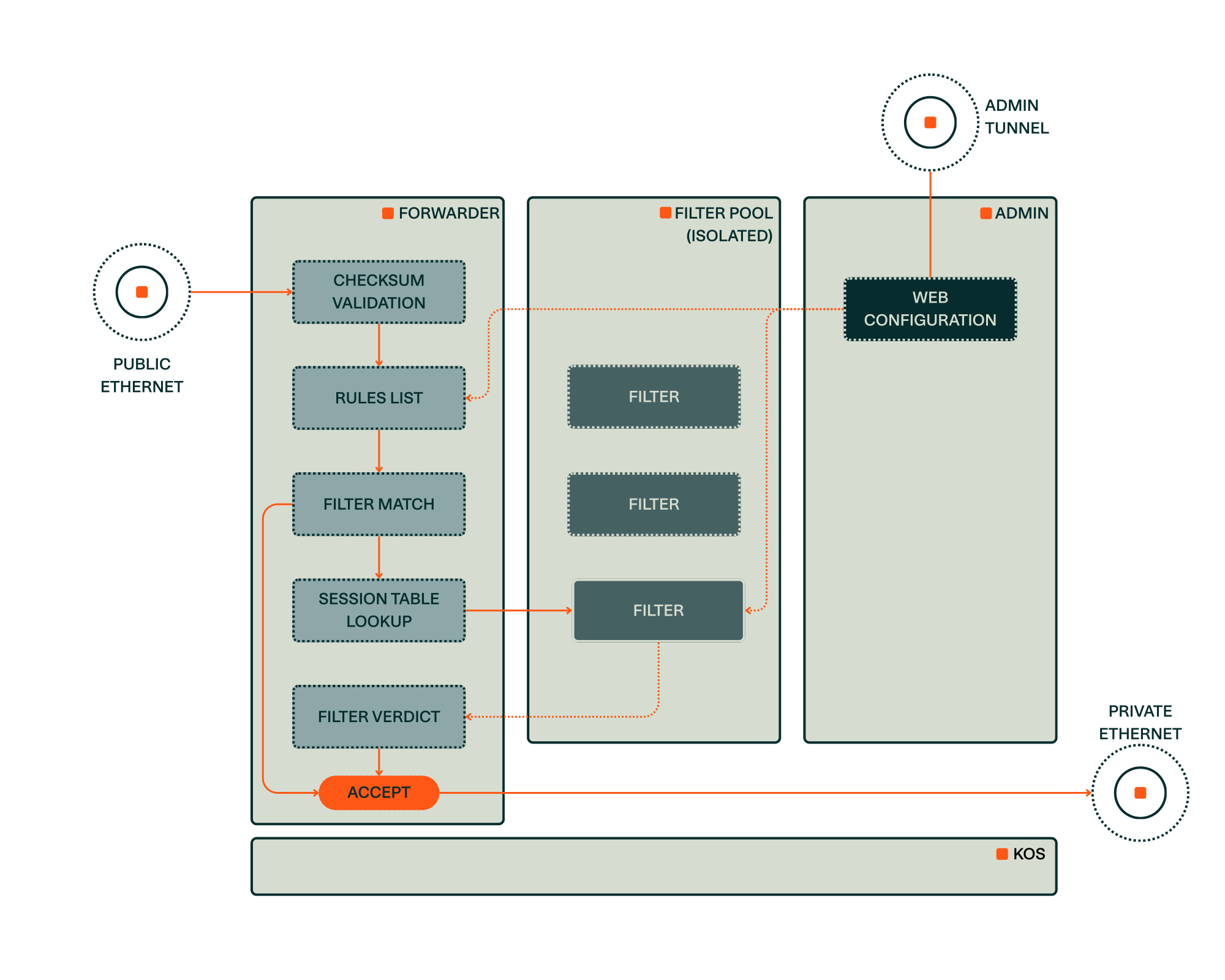
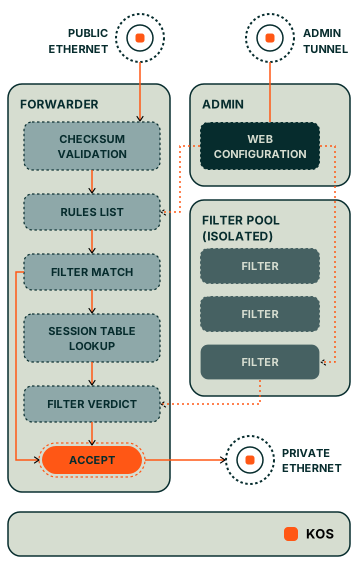
The Kry10 Medical Guard runs on the Kry10 Operating System, which is built on a formally verified microkernel foundation. KOS is a set of isolated applications rather than one monolithic program, and that structure is core to the problem this project is trying to solve.
The forwarder holds the rule set, tracks open connections and makes every routing decision, so it is the one component that has to be trusted. Deep packet inspection sits outside it, in filters that each handle a single protocol and that the guard is built never to rely on.
A filter can read only the packets assigned to it and can return only a verdict: pass, drop, reset, block. It cannot modify traffic, cannot route, cannot see another filter's connections, and cannot reach the forwarder. Every capability each component holds is declared at build time in a manifest a security team can read, and is enforced by the kernel at runtime.
Other solutions
-
OT Network Guard
Extend the operational life of in-service, certified equipment with an added layer of protection
Read more -
Workload Security
Build certainty into an uncertain world with secure management of AI workloads.
Read more -
KOS SDK
A secure, resilient OS for critical connected devices.
Read more